
Dyslexia Corner
Meeting My Dyslexia
by Kate Lumsden
It seems unbelievable now, but I couldn’t write when I was a child. Other kids had neat pencil-written sentences on their dotted-lined paper. I had a few clumsily drawn letters, each one representing a word, and just for funsies, I didn’t always select a letter that happened to be in the word it represented.
I know now that I probably had dysgraphia, a difference that makes it hard to physically write. I only found this out when my son’s third grade teacher told me that in his writing, he was regularly skipping words and sometimes paragraphs by doing a simple checkmark. My heart sank.
“Is he lazy?” I found myself asking.
It sounds awful, but I was only repeating what had been drilled into me. That adjective, “lazy,” had been used to describe me as a child. I was constantly told I was “slow” and “lazy,” even though I ran in circles and talked at hyperspeed, until finally my mom asked for me to be tested and we discovered my dyslexia.
I told my son’s teacher I’d had dyslexia when I was younger, but that I’d outgrown it.
He squinted at me. “You outgrew it?”
“Yeah,” I said. “I worked with dyslexia tutors for several years and then I was done. I finished. I graduated. We had a little ceremony. My mom bought a cake.”
With each of those sentences the teacher’s expression got a little squintier. Funny how quick you can realize you’ve been comically wrong for decades. My mom didn’t want me to be pulled out of class anymore. She didn’t want me to feel bad about myself. She decided I should be done with it, and after that we mostly pretended it never happened.
“Yeah,” my son’s teacher said slowly. “You should get him tested.”
Since my daughter in fifth grade still hadn’t worked out which way the letter S faced, she was tested too. We learned both of them were not only dyslexic, but twice exceptional. For spelling and phonics they rank near the bottom, for logistical reasoning and verbal intelligence near the top. They were given school support. I was given a book called Overcoming Dyslexia.
That book blew my whole world open.
In it were accounts of people just like me. “Lazy” people who did worthwhile things with their lives. Sure, I’d been a low achieving kid, but I’d turned it around in college. I’d gotten A’s in my doctoral program. I’d beaten the odds.
Only now I saw that I hadn’t known the odds. A lot of brilliant people, creative people, world changing people, were and are dyslexic. Maybe they weren’t creative and successful in spite of dyslexia. Maybe, just maybe, they were creative and successful because of it.
This is something I made myself remember every time my son brought home a report card or spelling test. That you can fail and still be okay. That some minds don’t work the same, and that doesn’t mean they work worse.
Unfortunately, some adults didn’t get that. They didn’t seem to understand how my son could struggle in one way and be brilliant in another.
Furious to be understood, I wrote the first draft of Confessions of a Mango in a month. I wrote it to show all the “lazy” kids—and their adults—that we can achieve great things not in spite of difficulty and failure, but perhaps because of them.
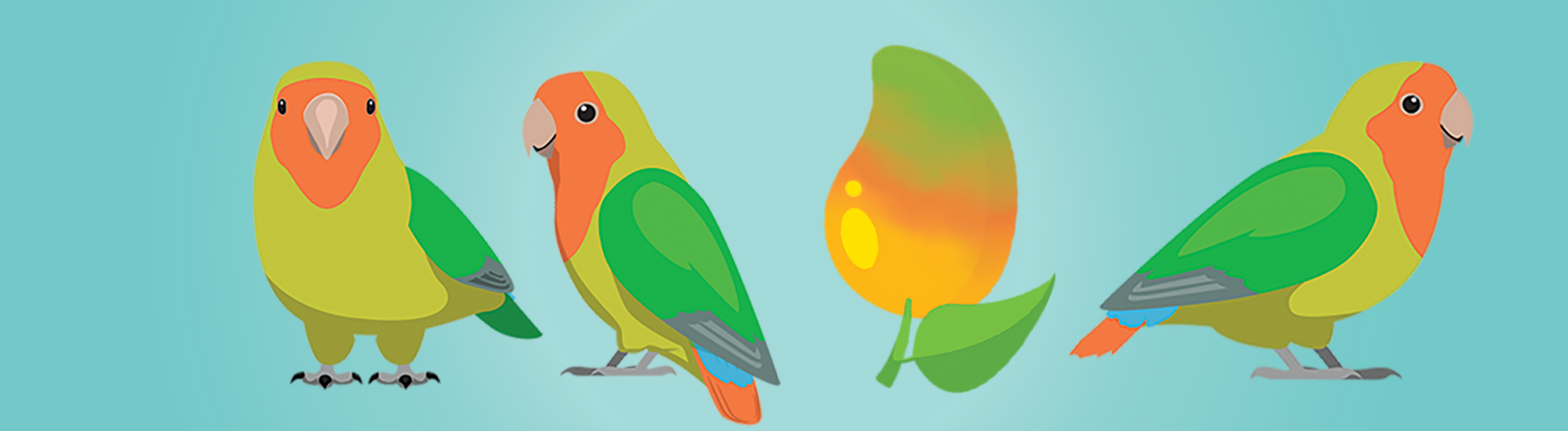
If you feel like a mango among lovebirds because of neurodiversity, just remember: you aren’t alone. And you aren’t broken. Even the lovebirds fail. It’s part of life. Sometimes we all need a reminder that you can fail and still be fine.
Dyslexia resources
Non-fiction books that help explain dyslexia
Overcoming Dyslexia – by Sally Shaywitz M.D.
The Dyslexic Advantage – by Brock L. Eide M.D., M.A. and Fernette F. Eide M.D.
A mid-grade novel about a girl with dyslexia
Fish in a Tree – by Lynda Mullaly Hunt
The International Dyslexia Association
Helpful tools for people with dyslexia
Opendyslexic – A typeface for dyslexia
Sora- Where Students Read